Image source: Anna Bruen, ICLEI Europe
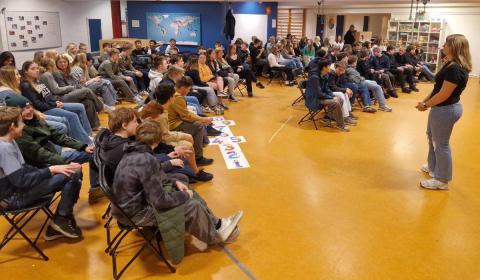
On 3 December 2025, the European research and innovation projects CLEVERFOOD, FEAST, FOODCLIC and SchoolFood4Change, jointly organized at the University of Copenhagen the workshop “From Policy to Action – Strengthening Food Security in Times of Uncertainty through Approaches Integrating One/Planetary Health & Biodiversity”. The session took place during the Danish EU Presidency Conference on Transformative Governance for Food Systems and Biodiversity and the wider EU Bioeconomy Event 2025.
The workshop brought together participants from academia, municipalities, EU-funded projects, civil society and international organisations. Its purpose was to explore how integrated One/Planetary Health and biodiversity approaches can be translated into concrete action to strengthen food security in a context of climate instability, biodiversity loss, public health challenges and growing social inequalities.
Why One/Planetary Health matters for food security
Human health, animal health and ecosystem health are deeply interconnected. Climate change, ecosystem degradation and unsustainable food production and consumption patterns are already driving food insecurity, preventable disease and social instability across Europe. One/Planetary Health offers a unifying framework to address these challenges together, rather than in isolation, while respecting planetary boundaries.
The workshop opened with a framing presentation on the current state of European food systems and the EU policy landscape, including the European Commission’s 2024–2029 objectives, the Vision for Agriculture and Food, and the upcoming 2028–2034 Multiannual Financial Framework. Participants were invited to reflect critically on whether food security and health are sufficiently integrated into these frameworks, and whether economic, environmental and social priorities are adequately balanced. A key message emerged early on: strengthening food security under uncertainty requires systems thinking, long-term policy coherence and governance models that address power imbalances to facilitate the integration of health and biodiversity as core principles.
An interactive “gallery” of food system challenges and solutions
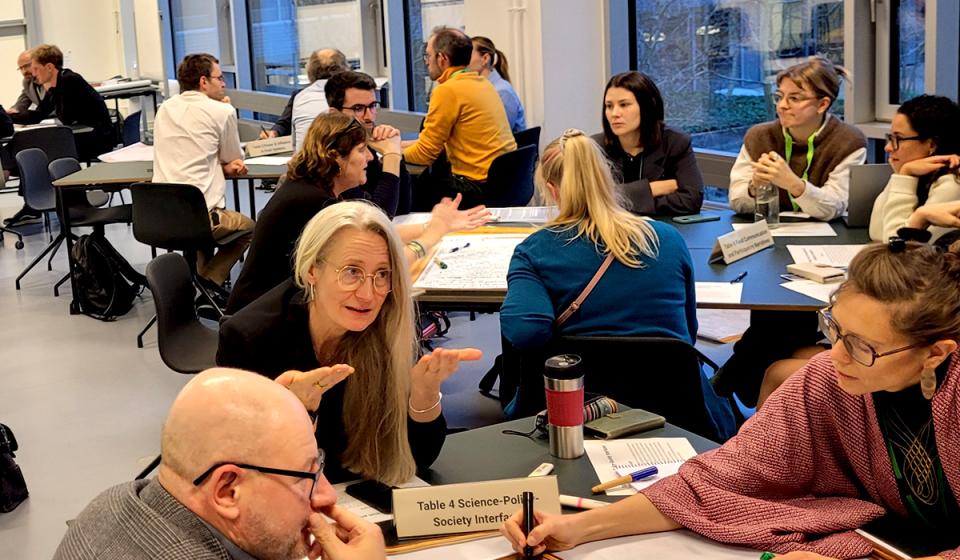
To support collective reflection and co-creation, the workshop used a World Café–style methodology built around a creative “art gallery” metaphor. Participants collectively developed six “framed pictures” responding to the guiding question: How can we advance food security through integrated health and biodiversity approaches?
The six thematic frames focused on:
- Climate, land use and spatial planning
- Health, nutrition and biodiversity
- Power and influence in food systems
- Science–policy–society interfaces
- Financing nature-positive food systems
- Food communication and participatory narratives
Key insights from the discussions
Across all themes, participants highlighted the complexity of food systems and the structural barriers that limit integrated One/Planetary Health approaches. Persistent power imbalances were repeatedly raised, including corporate and regulatory capture, opaque decision-making processes and the limited inclusion of local, regional and civil society perspectives. Food was often described as an institutional “grey area” between agriculture, health, climate, biodiversity and economic policy, making coordinated action difficult.
At the same time, the discussions identified concrete entry points for change. Participants stressed the importance of rebalancing power through inclusive governance mechanisms such as randomised citizens’ assemblies and stronger science–policy–society interfaces. Robust but proportionate monitoring and evaluation were seen as essential to demonstrate impact, while qualitative approaches, including storytelling and lived experience, were recognised as valuable forms of evidence that should not overburden local initiatives.
Existing governance tools were highlighted as underused leverage points for One/Planetary Health, including spatial planning legislation, public procurement, climate and health plans, and community-supported agriculture. Participants also emphasised the need to redirect financial flows and incentives to support nature-positive food systems, ensuring that healthy food is affordable and accessible for all and that producers are fairly rewarded for biodiversity-friendly practices.
A more critical insight was the widespread acknowledgement that many promising solutions currently operate at local or regional levels, while national and EU-level policies often lag behind or even hinder transformative change. This reinforced a shared view that we must capitalise on these local and regional level solutions while also working at the EU level where European institutions have an essential role to play in enabling just and resilient food systems, but that this requires greater transparency, inclusiveness and trust-building.
Looking ahead
Five overarching takeaways emerged from the workshop: the need to counter power imbalances through democratic governance; recognise food as a cross-cutting policy domain; activate agency at all levels; use existing leverage points more effectively; and reconnect farming, food and nature. For FEAST and its partner projects, the workshop reaffirmed that moving from policy to action depends not only on evidence, but on inclusive governance and a shared commitment to One/Planetary Health as a guiding framework for Europe’s food future.
Workshop Organisers and Contributors:
Anna Bruen, ICLEI Europe (FoodCLIC project); Anant Jani, University of Heidelberg (FEAST project); Jasmina van Driel, ZonMW, HDHL (CLEVERFOOD project); Dan Kristian Kristensen, City of Aarhus; Carina Bell Woollhead, Municipality of Guldborgsund;
Lars Nørgård Holmegaard, NbS Danish Hub, Klimatorium; Saher Hasnain, Roskilde University; Leonard Sandin, Nordic NbS Hub; Fabrice DeClerck, EAT Foundation; Ismael Erriest, EAT Foundation; Beatrice Ruggiero, ICLEI ES; Fabio Consalez , ICLEI ES